Get Expert IT Solutions For Your Business – Natural Group

-91 9090909090

support@nscspl.in

Struts (Open-Source FrameWork)

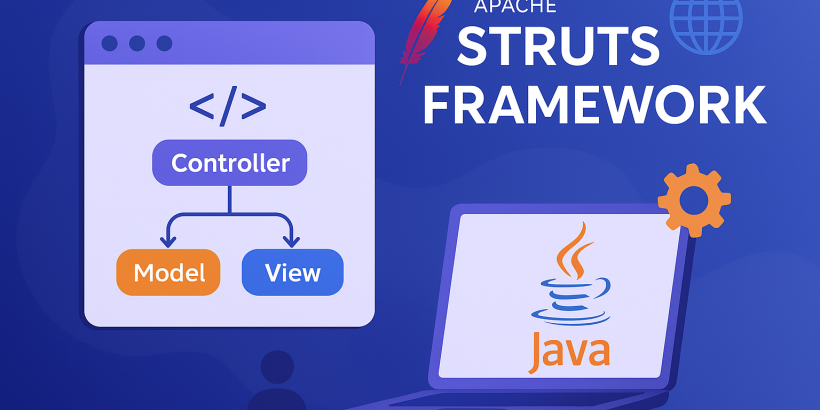
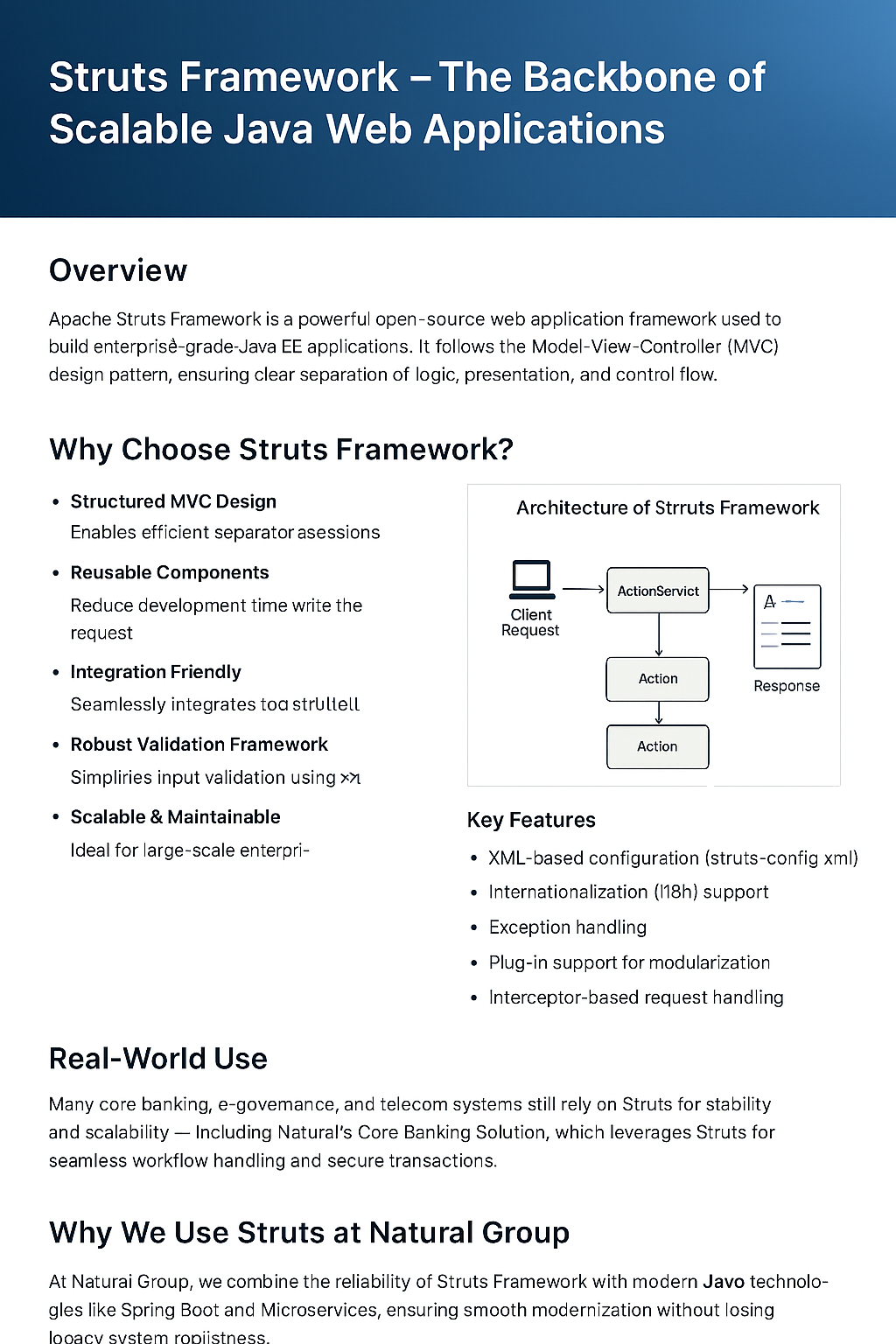
Apache Struts Framework is a powerful, open-source web application framework for developing enterprise-grade Java applications. In the banking domain, Struts plays a crucial role in building secure, scalable, and maintainable software — handling millions of transactions seamlessly.

At Natural Group, we leverage the Struts MVC architecture to build reliable, modular, and high-performing banking applications that ensure data integrity and real-time performance.

.

Understanding Struts Framework:


Apache Struts Framework is a powerful, open-source web application framework for developing enterprise-grade Java applications. In the banking domain, Struts plays a crucial role in building secure, scalable, and maintainable software — handling millions of transactions seamlessl:

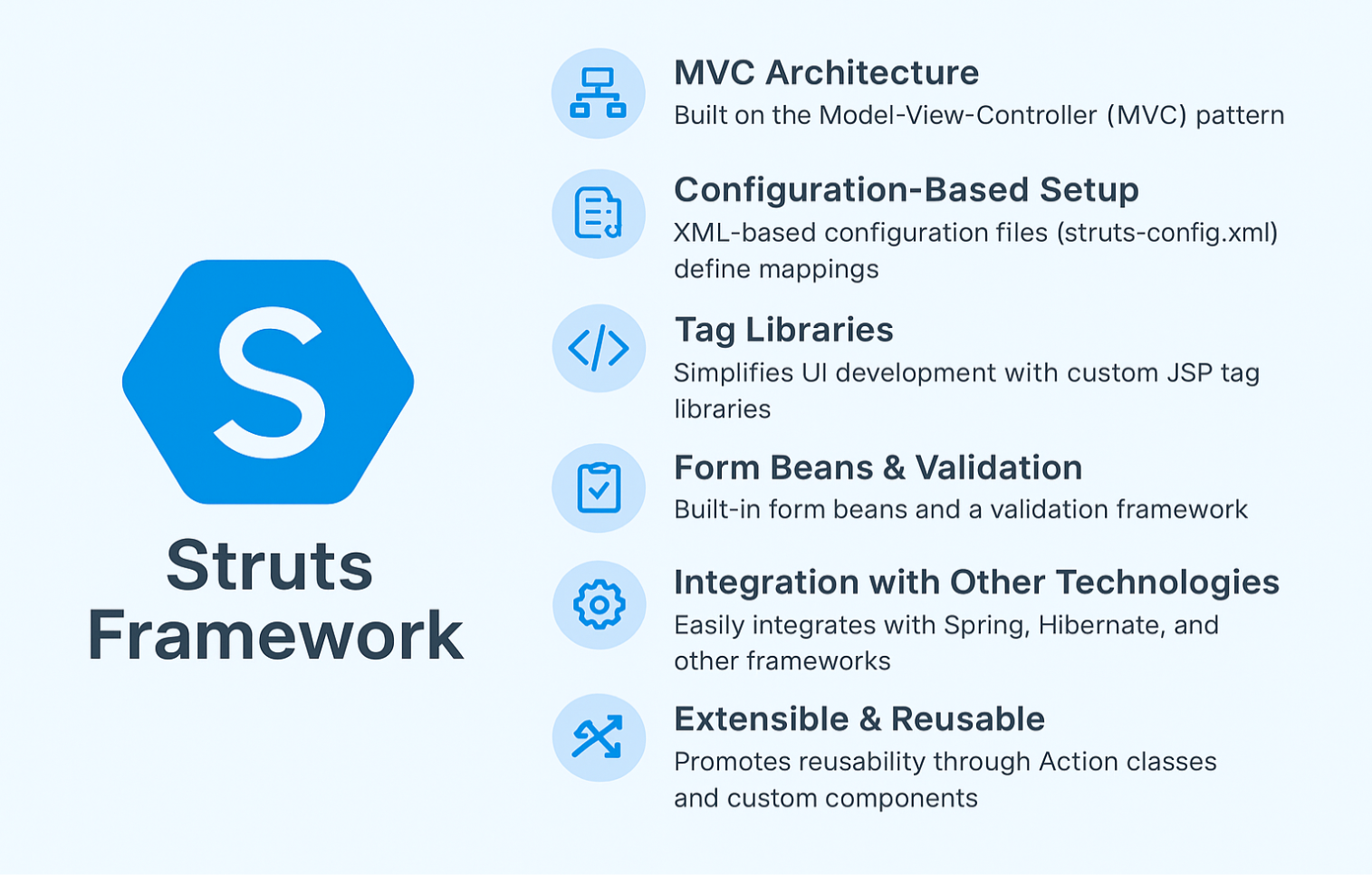
  • Configuration-Based Setup

    Struts uses XML-based configuration files (struts-config.xml) to define mappings between form beans, actions, and results — allowing developers to control flow without changing the code.

  • MVC Architecture

    Struts is built on the Model-View-Controller (MVC) pattern, which separates application logic, UI, and control flow — ensuring cleaner, modular, and maintainable code.

  • Suitable for Enterprise Applications

    With its robust architecture and well-defined flow, Struts has been a long-time choice for large-scale enterprise applications requiring stability and maintainability.

  • Integration with Other Technologies

    Struts can be easily integrated with Spring, Hibernate, and other enterprise frameworks — enabling developers to leverage modern technologies while maintaining Struts’ stability.

Benefits of Using Struts Framework:

Why many enterprise & banking systems choose Struts for reliability, maintainability and integration:


  • Structured MVC Architecture

    Clear separation of Model, View and Controller for modular development.
    Struts enforces MVC which simplifies testing, maintenance and team collaboration. UI updates don’t affect business logic.
  • High Maintainability
    Thanks to the MVC pattern, it’s easy to modify or upgrade components independently without affecting others

  • Scalability & Reliability
    Struts is proven in large-scale enterprise and banking software, handling thousands of transactions efficiently.

  • Enterprise Integration
    Integrates easily with legacy systems, EJBs, and ORM frameworks — suitable for core banking modernization..

Integration of Struts framwork with the Core banking Mobile Banking and ERP

Integrating Spring Boot with the Tender module brings several enhancements:

  • Core Banking System Integration

    The Struts framework plays a crucial role in developing and integrating Core Banking Systems (CBS) by providing a strong MVC (Model-View-Controller) architecture for complex business operations

    The Struts Controller communicates with Spring Boot microservices or API gateways that expose banking functionalities to mobile apps.

    • Authentication and authorization are managed through secure Action classes and interceptors, ensuring encrypted communication.

    • JSON or XML-based responses make it easy for mobile apps (Android/iOS) to consume the data.

    .

  • Maintainability:

    One of the most powerful advantages of using the Struts Framework in large-scale enterprise applications—such as Core Banking, Mobile Banking, and ERP systems—is its high maintainability.

    Struts follows a modular and layered architecture (MVC) that cleanly separates business logic, presentation, and data access layers

    .

  • Security:

    Security is a cornerstone of the Struts Framework, making it a preferred choice for financial institutions, enterprise systems, and banking applications where data confidentiality and transaction safety are critical.

    Struts provides a multi-layered security model that protects applications from common web vulnerabilities and ensures secure data flow between users, servers, and databases.

  • Form Validation and Input Sanitization

    Struts uses a robust form bean validation mechanism and the Validation Framework to automatically check user inputs.
    It prevents malicious data, SQL injection, and XSS (Cross-Site Scripting) attacks by validating and sanitizing input data before it reaches the server.

  • Integration with EJB and JBoss Security

    When Struts is combined with EJB components and deployed on the JBoss Application Server, it inherits enterprise-grade security features, such as:

    • Encrypted communication via SSL/TLS.

    • Secure transaction boundaries managed by the EJB container.

    • Declarative security policies configured at the JBoss level.

Conclusion

The Struts Framework has been a cornerstone of enterprise-grade application development, especially in banking and financial domains. Its robust MVC architecture, integration flexibility, and enterprise-level security make it an ideal choice for powering large-scale systems such as Core Banking, Mobile Banking, and ERP solutions. By combining Struts, EJB, and the JBoss Application Server, organizations achieve a stable, maintainable, and secure platform that supports millions of daily transactions with high performance and reliability. Even as modern technologies like Spring Boot and microservices gain popularity, Struts remains a proven and trusted foundation for legacy modernization — bridging traditional monolithic systems with next-generation digital banking architectures.

Call Now Button