Get Expert IT Solutions For Your Business – Natural Group

-91 9090909090

support@nscspl.in

JBoss / WildFly and Apache Integration

JBoss EAP (now WildFly) and Apache HTTP Server together form a powerful enterprise-grade application-hosting solution.
JBoss (from Red Hat) is a Java EE application server used to deploy large-scale, distributed applications, while Apache handles web traffic, load balancing, and SSL termination.
The combination provides a scalable, secure, and high-performance architecture—ideal for mission-critical systems such as Core Banking, Mobile Banking, and ERP solutions.

.

Key Feature

  • Java EE Full Stack Support – Deploy EJBs, JPA, JMS, and Web Services easily.

  • Clustering & Load Balancing – Supports horizontal scalability with session replication.

  • Seamless Integration with Apache – Via the mod_jk or mod_cluster connectors for smart routing.

  • Management Console & CLI – Centralized control for deployments, data sources, and logs.

  • Hot Deployment – Redeploy applications on the fly with minimal downtime.

  • Flexible Configuration – Domain Mode for centralized management across multiple servers.

  • Microservices and Container Support – Works with Docker and Kubernetes for cloud-ready environments.

  • Security Domains & JAAS – Provides granular access control for enterprise users.

  • Performance Optimization – Caching, connection pooling, and thread tuning for high throughput.

  • Cross-Platform Compatibility – Runs on Windows, Linux, and cloud VMs seamlessly.

  • Advantages

    • Scalable Infrastructure – Designed for large enterprise deployments.

    • Cost Effective – Open-source and license-free; lowers TCO.

    • Reliability & Stability – Proven in production for high-availability systems.

    • Integration Ready – Works smoothly with Struts, Spring, Hibernate, and database servers.

    • Easy Maintenance – Simple patching and version upgrades.

    • Modular Design – Start only the required services for faster startup and lower memory usage.

    • Community & Red Hat Support – Backed by an active ecosystem and enterprise support options.

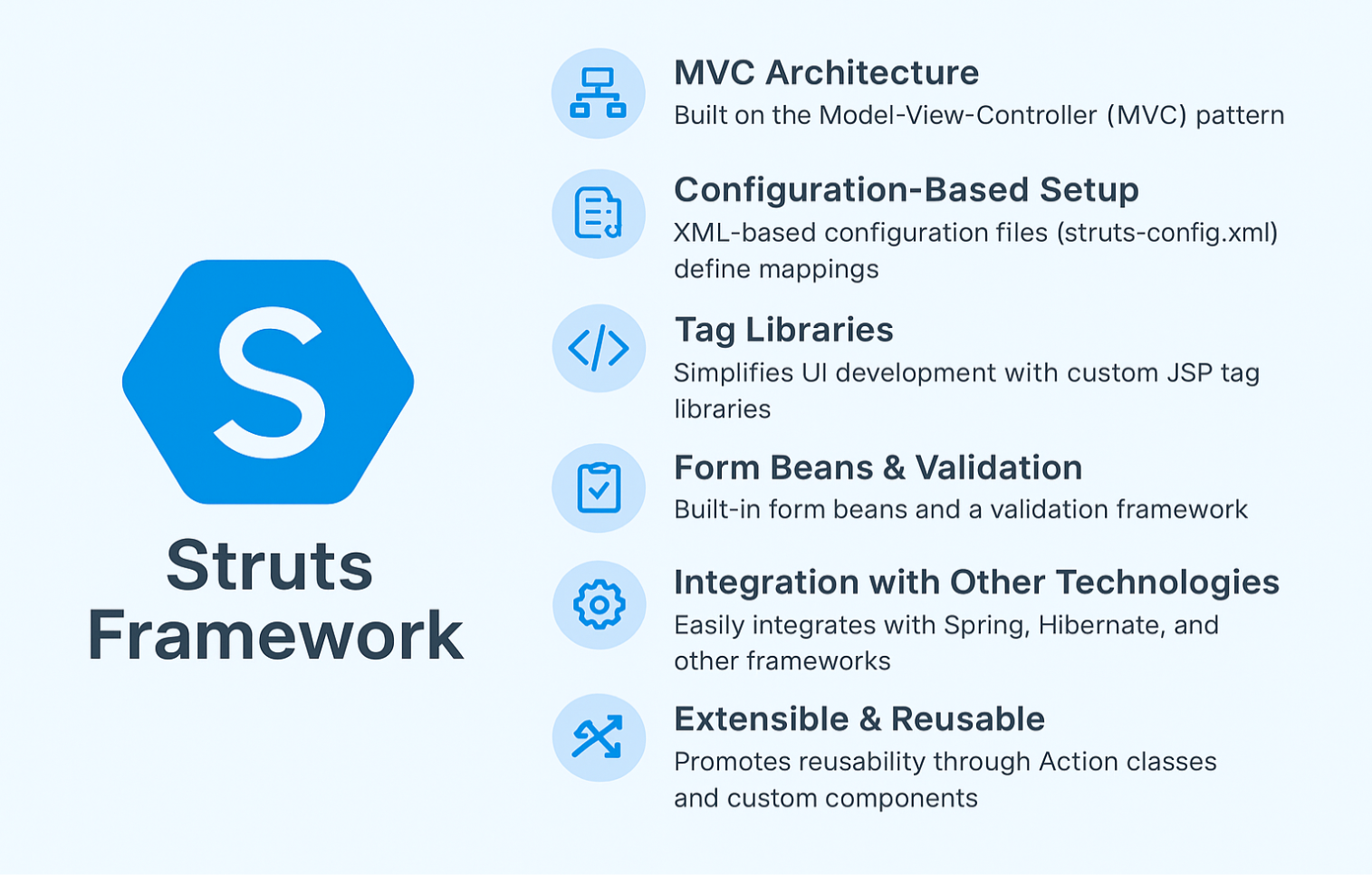
Benefits of Using Struts Framework:

Why many enterprise & banking systems choose Struts for reliability, maintainability and integration:


  • Structured MVC Architecture

    Clear separation of Model, View and Controller for modular development.
    Struts enforces MVC which simplifies testing, maintenance and team collaboration. UI updates don’t affect business logic.
  • High Maintainability
    Thanks to the MVC pattern, it’s easy to modify or upgrade components independently without affecting others

  • Scalability & Reliability
    Struts is proven in large-scale enterprise and banking software, handling thousands of transactions efficiently.

  • Enterprise Integration
    Integrates easily with legacy systems, EJBs, and ORM frameworks — suitable for core banking modernization..

Integration of Struts framwork with the Core banking Mobile Banking and ERP

JBoss / WildFly is an enterprise-grade Java EE application server used to run business logic (EJBs, servlets, REST APIs). In a banking or enterprise deployment, JBoss sits behind a web server or load balancer (commonly Apache HTTP Server) and exposes services to web portals, mobile apps, and ERP systems. Together they form a layered, secure, and scalable architecture:
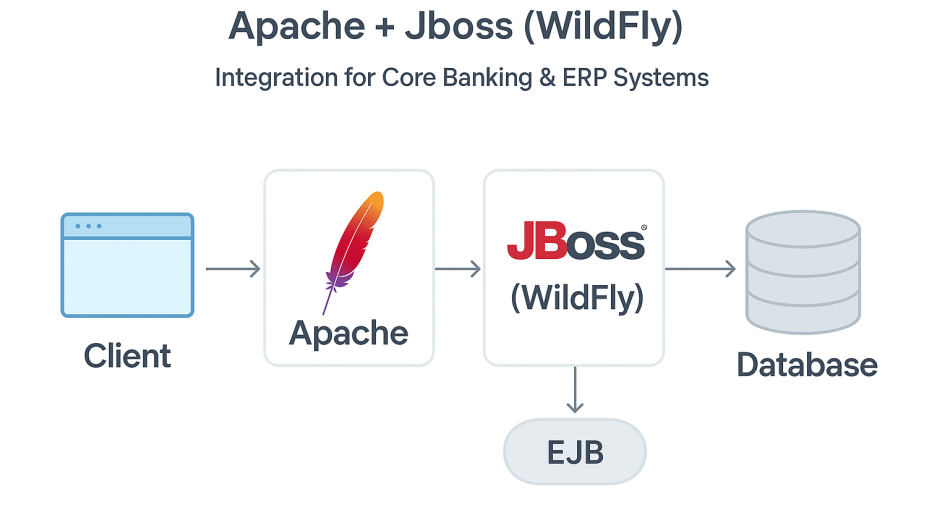
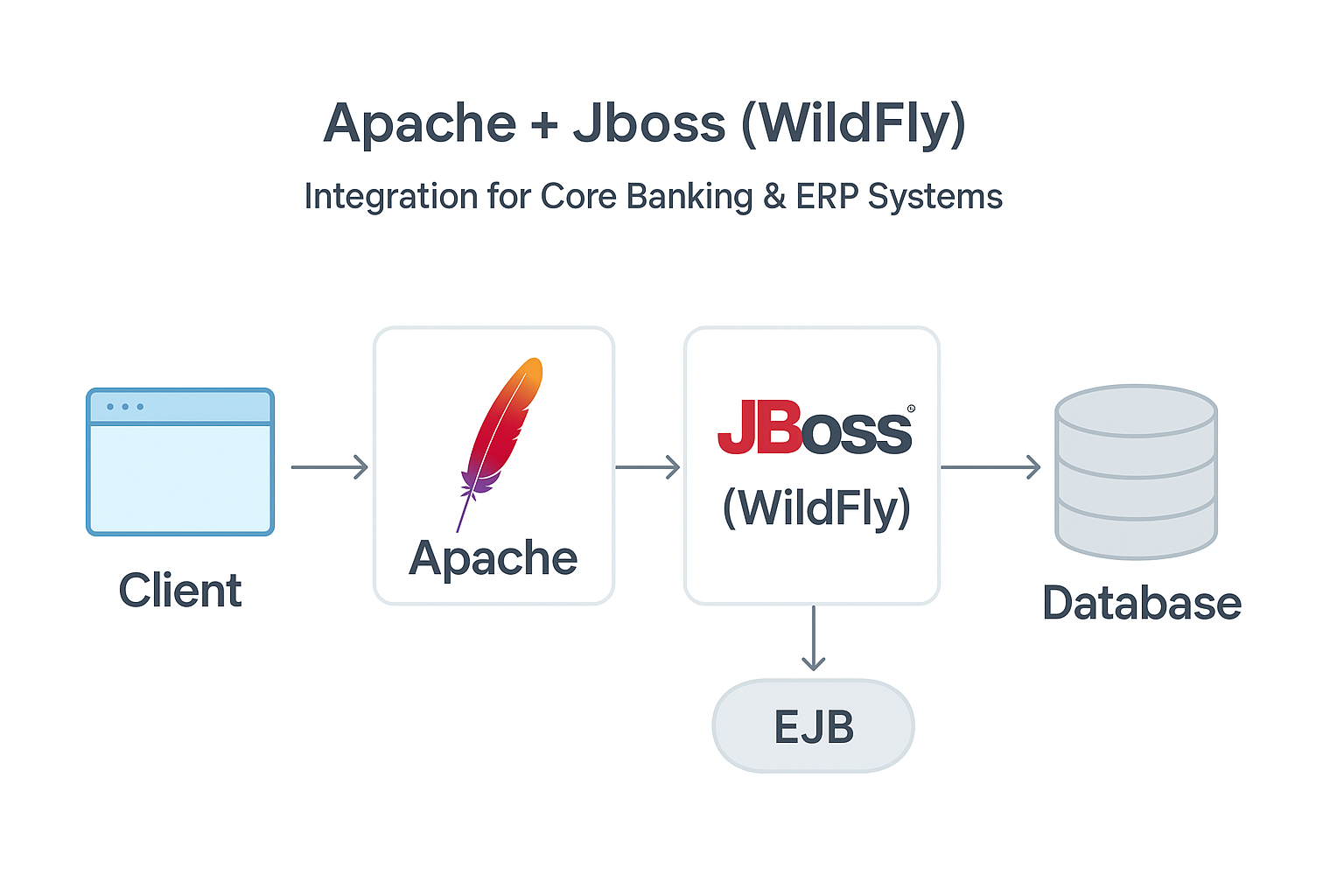
Client → Apache (front-end) → JBoss (application server, business logic, EJB) → Database / Messaging / External Systems.

  • 2. Integration Patterns & Architecture

    a. Reverse Proxy + Application Server

    • Apache handles TLS/SSL termination, static content, caching, and WAF rules.

    • Apache forwards dynamic requests to JBoss (via mod_jk, mod_proxy_ajp, or mod_cluster for dynamic node discovery).

    b. API Gateway / Microservices

    • JBoss hosts microservices and EJBs; mobile apps and external systems access them via REST/JSON endpoints or gRPC.

    • An API Gateway (Kong, Apigee, or Nginx) can manage rate-limiting, auth, and routing.

    c. Messaging & Async Integration

    • Use JMS (ActiveMQ, Artemis) for asynchronous tasks — e.g., posting transactions to downstream clearing systems or batch processing.

    d. Clustering & High Availability

    • JBoss supports clustering (session replication, distributed caches). Use sticky sessions or session replication with Infinispan for failover.

    Sample high-level flow:

    1. User web/mobile request → Apache (SSL)

    2. Apache → JBoss (load-balanced)

    3. JBoss → Service layer / EJB → DB (transaction)

    4. JBoss → JMS queue for async processing → downstream systems

    5. Response → Apache → Client


    3. Key Integration Touchpoints

    Core Banking

    • Expose transactional services (balance inquiry, funds transfer) as secure REST/SOAP endpoints or EJB remote interfaces.

    • Ensure transactions use JTA (managed by JBoss) for atomic commits across DB and messaging.

    Mobile Banking

    • Provide JSON REST APIs with OAuth2/JWT authentication or mutual TLS.

    • Use an API Gateway and CDN for performance. Keep controllers lightweight; heavy processing flows to JBoss service layer.

    ERP

    • Integrate via web services (SOAP/REST), JPA entities, or direct JDBC (careful with coupling).

    • Use scheduled batch jobs (EJB timers or Quartz) for reconciliation, payroll, or reporting.


    4. Security (Essential for Banking & ERP)

    Transport & Identity

    • TLS/SSL termination at Apache; use mutual TLS for internal APIs where necessary.

    • Use Elytron (WildFly) or integrate Spring Security for authentication/authorization.

    • Integrate with LDAP/Active Directory for centralized identity; support SSO (SAML, OIDC).

    Authorization

    • Role-based access via JAAS or Elytron security domains.

    • Use fine-grained method-level security for critical operations.

    Data Protection

    • Encrypt sensitive fields in DB (column-level) and use HSM/keystore for key management.

    • Use secure session handling; avoid storing sensitive info in HTTP session.

    Defenses

    • Validate all inputs (server-side), use prepared statements to avoid SQL injection.

    • Apply CSRF tokens, rate-limiting, WAF rules in Apache. Audit logs for transactions.


    5. Performance & Scalability

    Load Balancing

    • Use mod_cluster/mod_jk or hardware LB; prefer mod_cluster for dynamic node management with WildFly.

    Session Management

    • Use sticky sessions + session replication or stateless JWT tokens for scale-out.

    • Infinispan as distributed cache for session or shared state.

    Connection Pooling & DB Tuning

    • Configure datasource pool sizing in standalone.xml or domain.xml.

    • Use DB replicas for read-scaling and connection pool separation for read/write.

    Caching

    • Cache frequently read but rarely changed data (e.g., currency rates, lookup tables) using Infinispan.


    6. Operational / DevOps Considerations

    Deployment

    • Deploy .war/.ear` via WildFly management console, CLI, or CI/CD pipeline (Jenkins/GitHub Actions). Prefer immutable artifact pipelines.

    Monitoring

    • Expose metrics (Micrometer / Prometheus exporters), use JMX. Monitor thread pools, heap, GC, DB connections, queue depths.

    Logging & Tracing

    • Centralized logging (ELK / EFK). Use distributed tracing (OpenTelemetry / Jaeger) for transaction traces across services.

    Backups & DR

    • Database backups, periodic EJB state dumps if needed, and cluster-based failover with a tested recovery plan.

  • Integration with EJB and JBoss Security

    When Struts is combined with EJB components and deployed on the JBoss Application Server, it inherits enterprise-grade security features, such as:

    • Encrypted communication via SSL/TLS.

    • Secure transaction boundaries managed by the EJB container.

    • Declarative security policies configured at the JBoss level.

Conclusion

The JBoss WildFly + Apache stack forms the backbone of enterprise applications where performance, security, and scalability are crucial. From Core Banking Systems to Mobile Banking Apps and ERP Platforms, this combination ensures a stable environment capable of handling millions of transactions daily with maximum uptime and security. It’s the trusted choice for enterprises transitioning toward modern Java microservice architectures—without compromising on the robustness of traditional monolithic systems.

Call Now Button